Aug 19, 2026
I-Beam Levels vs. Box Beam Levels: What’s the Difference?
Learn the differences between I-beam and box beam spirit levels, including profile construction, weight, stability, durability and recommended applications.
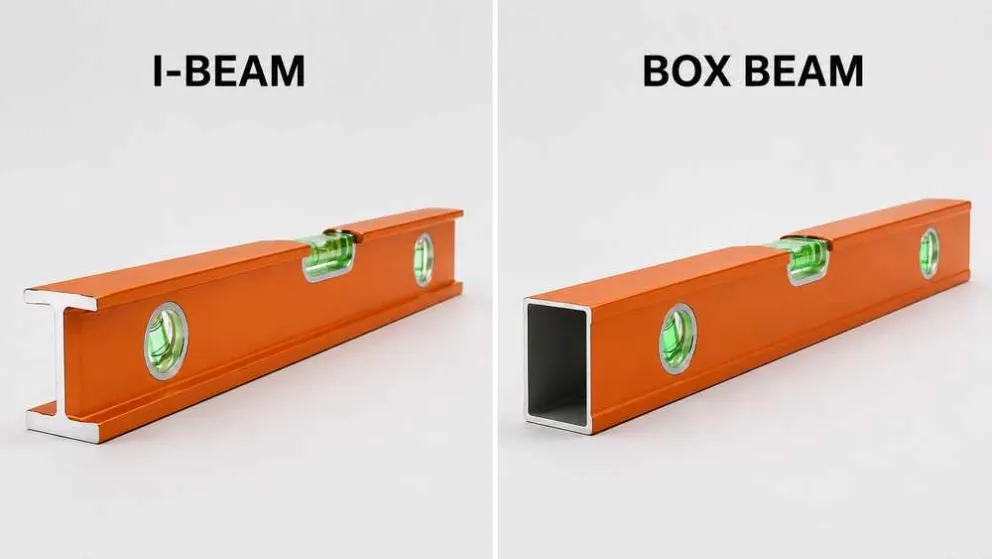
Spirit levels are available in several profile designs, but I-beam and box beam levels are among the most common. Although both are used to check horizontal and vertical alignment, their construction, weight and intended applications are different.
What Is an I-Beam Level?
An I-beam level uses an open aluminum profile shaped like a capital “I”. It has two reinforced measuring rails connected by a thinner central section.
This design reduces the amount of material required, making the level relatively lightweight and easy to carry. I-beam levels are practical for everyday installation, maintenance, woodworking and general DIY work.
Main advantages
- Lightweight and easy to handle
- Suitable for general installation and maintenance
- Usually more economical
- Easy to carry between jobs
- Available in multiple lengths
Because the profile is open, an I-beam level may provide less resistance to twisting or heavy impact than a comparable box beam level.
What Is a Box Beam Level?
A box beam level uses a closed rectangular aluminum profile. The four continuous walls form a rigid hollow chamber, providing a broad measuring surface and good resistance to bending and twisting.
This construction makes box beam levels suitable for professional construction, framing, masonry, window installation and other demanding applications.
Main advantages
- Strong closed rectangular profile
- Broad, stable measuring surfaces
- Good resistance to bending and twisting
- Suitable for frequent professional use
- Often available with integrated hand grips
Box beam levels may be slightly heavier, but the additional rigidity can be valuable when working with longer levels or in demanding jobsite conditions.
I-Beam vs. Box Beam: Quick Comparison
Feature | I-Beam Level | Box Beam Level |
|---|---|---|
Profile | Open I-shaped section | Closed rectangular section |
Weight | Lighter | Usually heavier |
Rigidity | Good for general use | Higher resistance to twisting |
Measuring surface | Narrower profile | Broad, stable surface |
Typical application | DIY, maintenance and installation | Construction and professional work |
Hand grips | Less common | Often available on longer models |
Price | Usually more economical | Usually higher |
Does Profile Design Affect Accuracy?
The profile influences stability and durability, but it does not determine accuracy by itself. Vial quality, installation method, aluminum straightness, machining precision and final calibration are equally important.
When comparing products, buyers should check:
- Stated measuring accuracy
- Vial visibility and shock resistance
- Aluminum wall thickness
- Milled or finished measuring surfaces
- Magnetic or non-magnetic base
- End-cap protection
- Available lengths
- Hand-grip design
Which Spirit Level Should You Choose?
Choose an I-beam level when low weight, convenient handling and everyday versatility are the main priorities. It is a practical option for general installation, maintenance and DIY applications.
Choose a box beam level when greater rigidity, a broad measuring surface and long-term jobsite durability are more important. It is generally better suited to professional construction and demanding use.
Both designs can provide reliable measurements when they are manufactured and calibrated correctly. The right choice depends on the working environment, required length, frequency of use and target price.